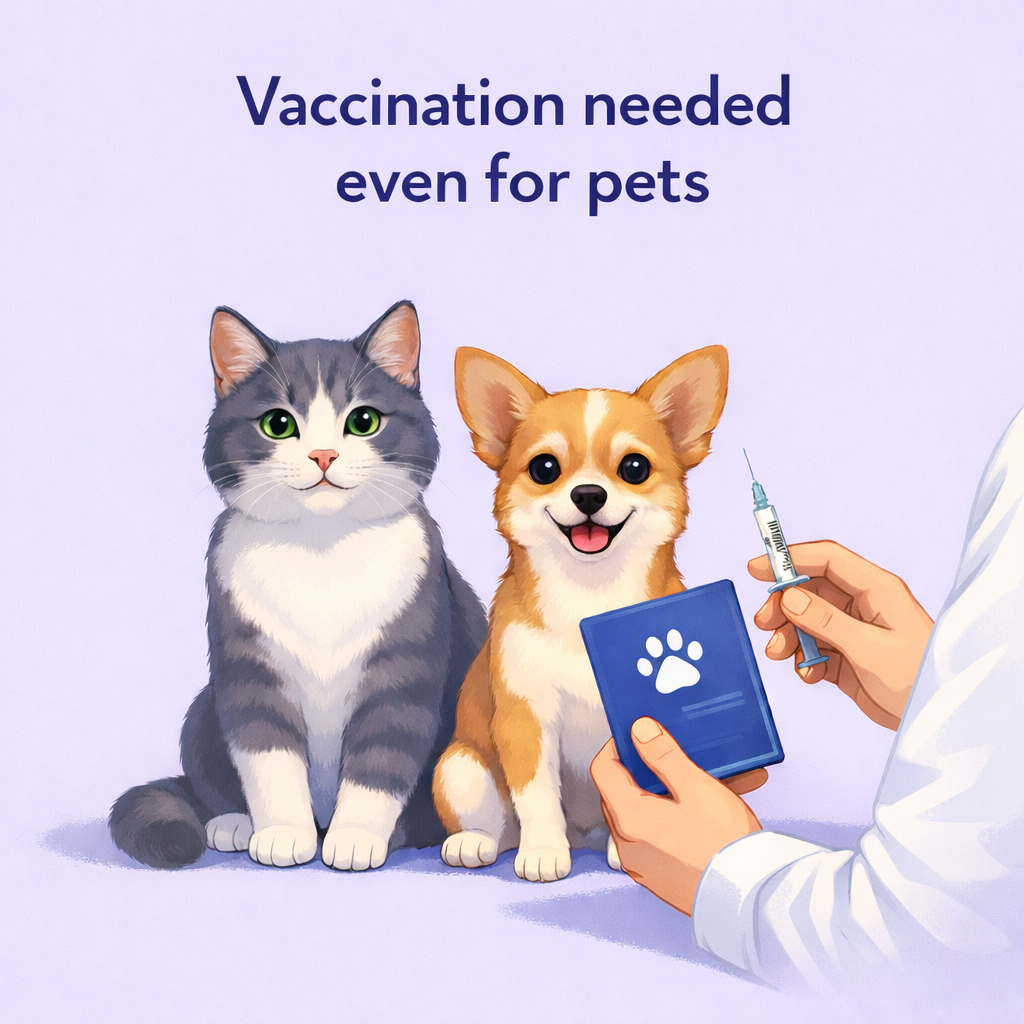
A phrase we hear more often is: “but he lives at home”.
At first glance, it sounds logical. If a cat never goes outside, the dog only walks “right near the house”, and the apartment is clean and cozy, it feels like infections simply have no way in.
The problem is that viruses and bacteria don’t need keys to your apartment. Shoes, delivery couriers, guests with pets, carriers from pet stores, or one unplanned contact are more than enough.
Below are the most common myths about vaccination and how things actually look in real veterinary practice.
Our clinic statistics (Shunn u Katun, Vanadzor)
We reviewed patient visits over the past 12 months and focused on situations where vaccination could have prevented severe disease or significantly reduced its impact.
About 63% of new patients came in without up-to-date vaccinations or with a lapse of more than one year.
Among unvaccinated indoor cats, around 46% of owners were confident that if a cat doesn’t go outside, vaccinations aren’t necessary.
During the season, we consistently see 10–15 puppy cases per week with severe vomiting and diarrhea (parvoviral enteritis or canine distemper). In every case, the scenario is the same: the puppy was not vaccinated.
Myth 1. “If a pet doesn’t go outside, vaccines aren’t needed”
Fact: you go outside every day. And then you come back home.
Many pathogens survive well in the environment and easily reach your hallway on shoes, outerwear, bags, or hands after being outside. There are also situations people often forget about: repair workers, guests, a rescued animal staying “just for a few days”, contact with another pet’s carrier, or an open door and “he only stepped into the stairwell for a second”.
A very typical case from practice. A 4-year-old cat, strictly indoor, “never been outside”. Never vaccinated. At some point, a relative’s kitten comes to stay “for a week”. After 10–14 days, the adult cat develops fever, lethargy, refusal to eat, and inflamed mucous membranes. The owners are shocked: how could this happen if he lives at home? The result is treatment, IV fluids, repeated tests, and a lot of stress. Vaccination is not a 100% guarantee, but it dramatically reduces the risk of severe disease.
Myth 2. “Vaccines are more dangerous than the disease”
Fact: modern vaccines usually cause a short, mild reaction, not “the disease itself”.
Sometimes pets may feel sleepy, have a mild fever, or tenderness at the injection site. This is expected and temporary.
Serious adverse reactions are rare. Real infections, unfortunately, are much more common and far more expensive in every sense.
How this looks in real life. A 3-month-old puppy. Vaccination was planned, but first “there wasn’t enough time”, then “we’re leaving for a few days”, then “after the holidays”. On walks, the puppy sniffs everything (as puppies do). What follows is vomiting, diarrhea, dehydration. Treatment begins.
It’s important to understand: without treatment, mortality from parvovirus can reach 80–90%. With timely intensive therapy, survival rates are usually 70–90%, but with late presentation the prognosis worsens sharply. In canine distemper, outcomes are often even more severe.
Myth 3. “One round of vaccines in childhood is enough”
Fact: immunity weakens over time. Revaccination is how protection is maintained.
Schedules vary depending on the vaccine and individual situation, so it’s best to confirm timing with a veterinarian. The principle is simple: if the recommended interval has passed, protection should be renewed.
A typical adult case. A 6–8-year-old dog, vaccinated “a long time ago”. Lives with a family, occasionally visits a groomer, sometimes goes to the countryside. Then coughing, lethargy, fever appear. The owner thinks it’s “just a cold”. The result is treatment, contact restrictions, and the inevitable question: why wasn’t this done on time?
Myth 4. “If we don’t travel abroad, rabies vaccination isn’t necessary”
Fact: rabies is not about travel. It’s about reality. Armenia is considered a high-risk (red zone) country for rabies.
There are wild animals, bites, and unpredictable encounters. If a pet is bitten by an unknown animal, vaccination immediately becomes an urgent, critical issue.
The risk may seem small. But the cost of a mistake with rabies is always maximal — and it also puts people at risk.
Myth 5. “Vaccination isn’t allowed during teething / stress / when the pet is too young”
Fact: what matters is not a mythical “perfect moment”, but the animal’s actual condition.
There are real contraindications: high fever, significant illness, some chronic conditions during flare-ups. That’s why we always examine pets before vaccination.
Postponing vaccination “for a month or two” simply because “he’s still small” is a poor strategy. Young animals are the most vulnerable and need timely vaccination the most.
An important point: vaccination does not make pets immortal
It does not provide a 100% guarantee that a pet will never get sick. But it significantly reduces the risk of severe disease and provides about 90–95% protection against infection.
Simply put, vaccination helps prevent situations that end with IV drips, night shifts at the clinic, and panic at home. And yes, it is usually much cheaper than treating a disease after it has already developed.
What to do now?
If you’re not sure whether your pet is vaccinated according to the current schedule, that’s completely normal. Most people don’t keep these dates in mind.
Message us or stop by for a short check-up. We’ll review the vaccination record (if available), clarify the details, and create a clear plan: what needs to be done and when.
Attention: indoor pets need vaccination too. Viruses don’t read signs that say “outdoor animals only”.
Shunn u Katun Veterinary Clinic
Vanadzor, Tumanyan 7
+374 55 895495
If you have questions about vaccinations, contraindications, or schedules, write or call us — we’ll review your specific case.