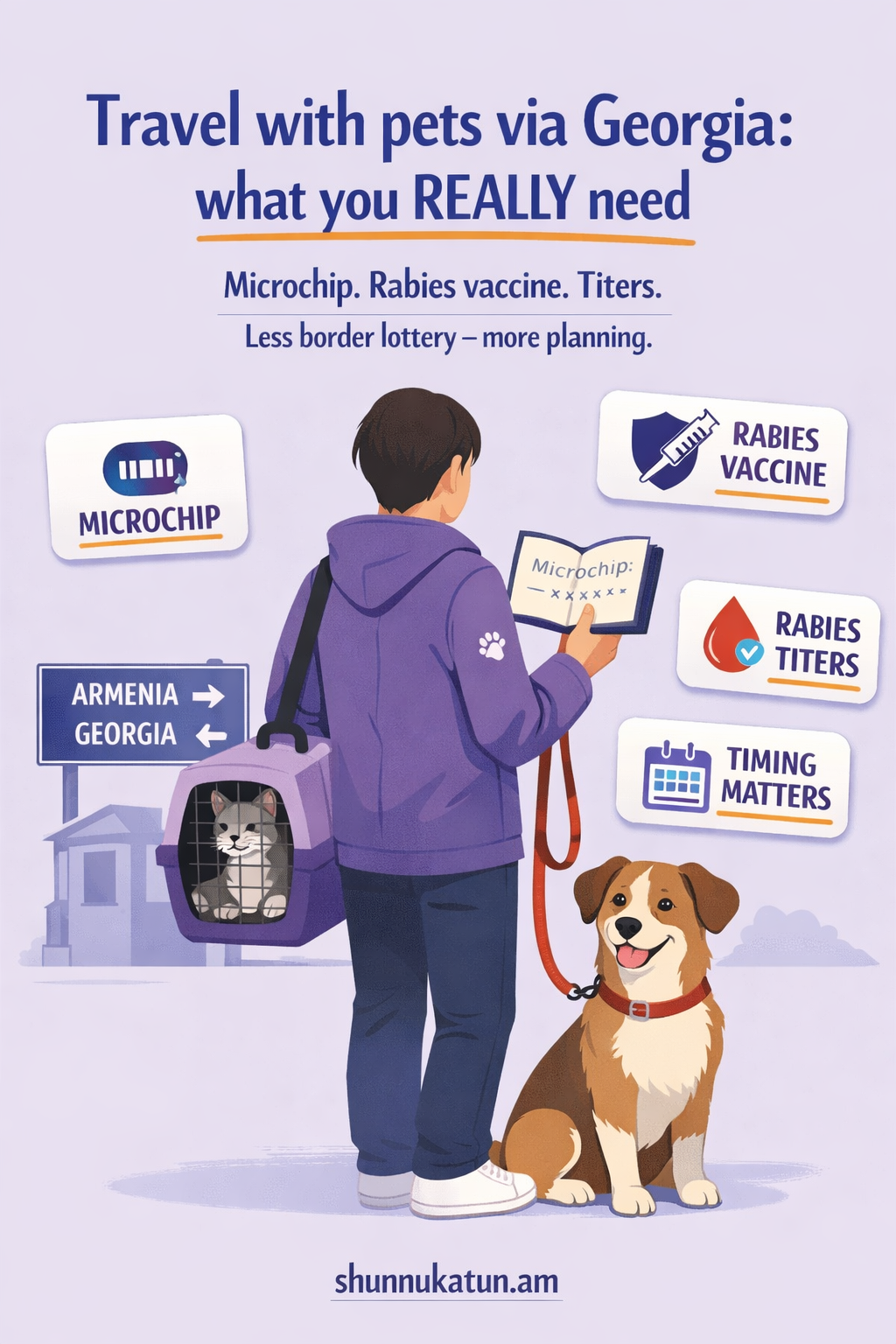
There are two common types of trips involving the Georgian border.
The first is a direct trip to Georgia - by car, bus, or plane.
The second is transit: Georgia is only a corridor, and you are traveling further (for example, to Russia or the EU), with the Armenia-Georgia border being an обязательный этап.
On paper, everything looks simple: a microchip and a rabies vaccine. In reality, over the past year we have seen a clear and growing trend - pet owners are increasingly being turned back at the Armenia-Georgia border due to missing microchips and/or missing rabies antibody titers.
Yes, inconsistency still exists. Some travelers are allowed through with only a microchip and vaccination, while others are required to present the full package: vaccination, microchip, rabies titers, parasite treatments, and properly оформленные documents. However, the number of refusals when titers are missing is steadily increasing.
Based on our internal data at the veterinary clinic "Shunn u Katun" (Vanadzor), we currently see 50-70 consultations per month related specifically to situations such as: "we were turned back" or "we are afraid we will be turned back." And this number continues to grow.
This article is a realistic, no-illusions breakdown of what is officially required, what is demanded in practice, and how to prepare documents so that your trip does not turn into a frustrating quest of "we went on a journey and came back for titers."
Why You May Be Turned Back at the Border?
The most common reason is relying on "maybe it will work." Unfortunately, the border is not a place for improvisation.
Typical refusal scenarios include:
- The pet does not have a microchip. A veterinary passport and vaccination may exist, but without identification it is impossible to prove that the vaccine was administered to this specific animal.
- The microchip was implanted after the rabies vaccination. For many countries (especially if the next destination is the EU or the United Kingdom), such vaccination is considered invalid and must be repeated.
- No rabies antibody titers. This is where confusion is most common: some online sources claim that titers are not required for entry into Georgia, while others say they are. In practice, border control increasingly acts as if titers are mandatory.
- No valid veterinary certificate, or it is filled out incorrectly. Border officers carefully check dates, stamps, signatures, microchip numbers, and matching owner details.
- No parasite treatment records. Even if someone you know was not asked for them, it does not mean you will not be.
What Official Sources Say About Importing Pets into Georgia?
Official guidelines for the non-commercial import of pets (dogs, cats, ferrets) consistently list the same core requirements:
- animal identification (microchip)
- valid rabies vaccination
- rabies antibody titration test
- treatment against internal and external parasites
- correctly issued veterinary passport or Health Certificate
- limits on the number of animals (usually no more than 5)
It is important to understand that countries classify regions differently based on rabies risk and may introduce exceptions. This creates the impression that requirements are inconsistent. If your goal is predictable border crossing, the strategy is simple: prepare the full set of documents.
Why There Is a Sense of "Randomness" at the Armenia-Georgia Border?
We see three main reasons.
First, conflicting information sources. Many guides online apply to air travel or to other countries, but are not suitable for land border crossings from regions with stricter control.
Second, people mix up the requirements for entering Georgia with the requirements of their final destination. If you are traveling to the EU, rabies titers are almost always mandatory in advance, and this may already be checked at the Georgian border.
Third, the human factor. Different border shifts, inspectors, and levels of strictness. One day someone passes with a certain document set, and the next day another person with the same documents is turned back.
The bad news: this happens. The good news: proper preparation significantly reduces the risk.
Preparing Without Surprises: A Practical Step-by-Step Approach:
Step 1. Microchip
A microchip is not optional. It is the link between the animal and its documents.
Critical point: the microchip must be implanted before the rabies vaccination, or on the same day with proper documentation. Otherwise, the vaccination may be considered invalid for international travel.
Step 2. Rabies Vaccination
For primary vaccination:
- administered no earlier than 12 weeks of age
- typically followed by a minimum waiting period of 21 days before travel
Regular revaccination without missed deadlines significantly simplifies further procedures.
Step 3. Rabies Antibody Titers
This blood test confirms that the pet has developed a protective immune response.
Standard international procedure:
- blood sampling no earlier than 30 days after vaccination
- result must be at least 0.5 IU/ml
- for certain destinations (especially the EU), a 3-month waiting period after blood sampling is required
Rabies titers always require planning. They are not a last-minute solution.
Step 4. Parasite Treatments
Treatment against internal and external parasites is often checked. Documentation must include:
- date
- product name
- veterinarian’s signature and stamp
Step 5. Veterinary Certificate (Health Certificate)
This official document confirms that the animal is clinically healthy and fit to travel.
Common issues include:
- owner’s name does not match passport
- missing or incorrect microchip number
- illegible vaccination dates or missing stamps
- expired certificate (many countries have short validity periods)
Three Typical Travel Scenarios:
Traveling Only to Georgia and Back
For a predictable trip, a full document set is recommended: microchip, rabies vaccination, titers, parasite treatments, and certificate. Relying on luck is becoming increasingly unreliable.
Traveling Through Georgia to Another Country
Even if the destination country has different requirements, you must still pass Georgian border control. If there are doubts about document accuracy, allow extra time.
Traveling Through Georgia to the EU or the United Kingdom
Rabies titers are almost unavoidable here, and timing is crucial. Without titers, the route may fail even if other documents appear correct.
Pre-Travel Mini Checklist
For maximum predictability at the border, make sure you have:
- a microchip with the number recorded in all documents
- rabies vaccination administered after microchipping
- rabies antibody titers (especially if transiting to the EU)
- parasite treatments with proper records
- a valid veterinary certificate / Health Certificate
Practical tip: take photos of all pages of the veterinary passport and certificates. This helps if documents are lost or damaged.
If You Are Turned Back at the Border
Rabies titers and the correct sequence "microchip - rabies vaccination - waiting periods" cannot be fixed on the spot.
Possible scenarios:
- missing microchip can usually be resolved relatively quickly
- incorrect vaccination timing requires waiting
- missing titers mean at least 45-60 days, and for EU destinations, several months
Conclusion: do not plan preparation "the day before the trip."
How We Can Help
At the veterinary clinic "Shunn u Katun" we assist with travel preparation:
- microchipping
- rabies vaccination with sequence verification
- route and timeline consultations
- rabies antibody titer testing
- document review to avoid critical mistakes
The earlier preparation begins, the higher the chance that your trip will be smooth and stress-free.
Sources
- Embassy of Georgia to the Republic of Armenia - Veterinary Control of Domestic Animals: https://armenia.mfa.gov.ge/en/veterinaruli-kontroli
- USDA APHIS - Pet Travel From the United States to Georgia: https://www.aphis.usda.gov/pet-travel/us-to-another-country-export/pet-travel-us-georgia
- USDA APHIS (PDF): https://www.aphis.usda.gov/es/print/pdf/node/3643
- EU Your Europe - Travelling with pets: https://europa.eu/youreurope/citizens/travel/carry/pets-and-other-animals/index_en.htm
- European Commission - Designated laboratories for rabies antibody titration tests: https://food.ec.europa.eu/animals/movement-pets/designated-laboratories-performing-rabies-antibody-titration-tests_en
- European Commission - Non-commercial movement from non-EU countries: https://food.ec.europa.eu/animals/movement-pets/eu-legislation/non-commercial-movement-non-eu-countries_en
- PetTravel - Republic of Georgia Pet Import Requirements: https://www.pettravel.com/information/pet-passports/republic-of-georgia-pet-import-requirements/
- ExpatHub - Pets in Georgia: https://expathub.ge/pets-in-georgia-country/
- GOV.UK - Rabies blood tests: https://www.gov.uk/bring-pet-to-great-britain/rabies-blood-tests