

We often hear two questions at the clinic: ‘Why does it cost this much?’ and ‘Can it be cheaper?’ Both are understandable. Treatment cannot always be planned in advance, and the expense often arrives at an anxious moment. Here is what sits behind the figures in our price list and what we can offer when paying the whole amount at once is difficult.
What makes up the cost
Every figure in the price list reflects specific work and the clinic’s essential running costs.
- Medicines and single-use supplies.
- Laboratory tests, maintaining the operating room and running equipment.
- The veterinarian’s time, knowledge and responsibility, as well as the assistant’s work.
- Rent, electricity, heating, water and cleaning.
Part of the income goes back into the clinic. It pays for medicines, equipment upgrades and professional training.
What an initial appointment includes
An initial appointment with a consultation costs AMD 7,000 and usually takes 20 to 40 minutes. During that time, the veterinarian:
- reviews the animal’s medical history and the owner’s concerns;
- examines the animal;
- answers questions;
- prepares a diagnostic and treatment plan.
A few prices from our current list
This is not the full price list. These are examples of services people ask us about most often. The prices are current as of 9 October 2026.
| Service | Price |
|---|---|
| Initial appointment with consultation | AMD 7,000 |
| Follow-up appointment for the same problem within 14 days | AMD 4,000 |
| Consultation without an examination, up to 30 minutes and without a written opinion | AMD 5,000 |
| Complete blood count with ESR | AMD 6,000 |
| X-ray examination | AMD 12,000 |
| Abdominal ultrasound for cats and dogs up to 5 kg | AMD 10,000 |
| Animal microchipping and data registration | AMD 15,000 |
| Male cat neutering | AMD 10,000 |
| Routine female cat spay without complications | AMD 26,000 |
The price list has separate entries for ultrasound examinations, vaccinations, anaesthesia and many operations. The fee depends on the animal’s weight, the medicine used and the scope of the procedure, so a course of treatment may include several services. We are ready to explain each item and why it is needed before treatment starts.
Why we do not bargain
A discount without a clear basis leaves part of the real cost uncovered, whether that is the team’s wages, supplies or a necessary medicine. We therefore do not change a service fee through bargaining. We are, however, ready to work with you on a manageable order of steps.
- Split diagnostics or treatment into stages and decide what needs to happen first.
- Choose a suitable alternative medicine when the veterinarian considers one appropriate.
- Offer a preventive-care package or a current special offer.
- Discuss instalments in cases where they are available.
Regular clients, animal welfare volunteers and advocates may also take part in our social programmes.
How to compare prices between clinics
The same service name can cover a different amount of work. Before choosing, it helps to ask:
- how long the appointment lasts and what it includes;
- what facilities, equipment and diagnostics are available on site;
- which medicines, supplies, anaesthesia and monitoring are included in a procedure;
- whether a charity or another programme subsidises the price.
We work in a clean clinical setting, use trusted medicines and keep the necessary stages of care in the plan. A lower figure on the price list does not justify removing a needed step.
Special offers and competitions
From time to time, we run spay and neuter campaigns. They bring the clinic very little income, but they reduce the cost for owners and help prevent unwanted litters. We also run social-media competitions whose winners receive a certificate for a free initial appointment or another service.
What the clinic has already done through social programmes
Over more than three years of work, we have put more than AMD 8,000,000 towards animal treatment and spay and neuter procedures. This work includes:
- co-funding spay and neuter procedures for more than 600 animals;
- treatment for more than 200 animals;
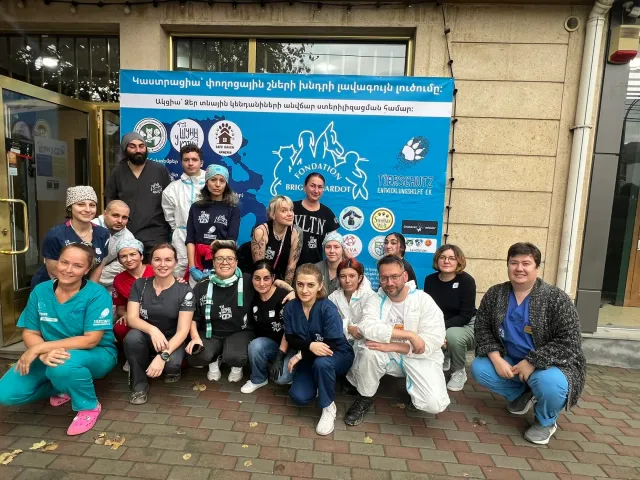
- 1,264 free procedures from April 2025 through October 2026 with support from Tierschutz Entwicklungshilfe e.V., Fondation Brigitte Bardot, other partners and sponsors;
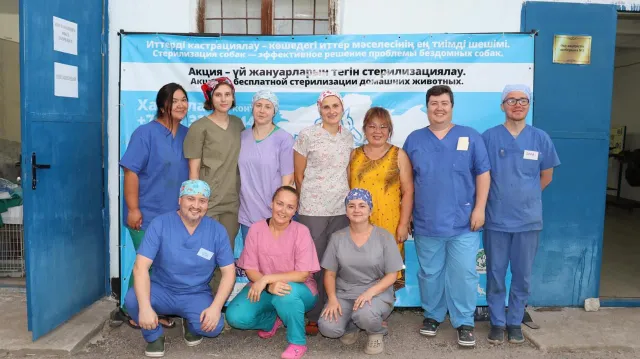
- our veterinarians’ volunteer work in an international campaign in Kazakhstan, where the team completed 1,850 procedures over 25 days.
We publish only some of these cases because there is not enough time to tell every story in detail. The clinic has no permanent sponsor or government support. Our social work depends on the clinic’s own work, volunteer participation and support from people who care about it.
When the budget is smaller than expected
A young kitten was recently brought in for an appointment. The examination showed that several tests were needed, and the total was higher than the owner had expected. Instead of reducing the fee, we suggested splitting the diagnostic work into two stages.
This spread the cost over time, and the kitten received the necessary treatment. We discuss solutions like this case by case. First we establish the care that is needed, then we look for a realistic way to organise it.
Our principle
A price should be understandable. We are ready to explain the purpose of a procedure, what the fee covers and the order of treatment. That conversation helps owners plan costs while preserving the standard of care their animal receives.
You can support our social programmes with a donation, volunteer help or by sharing information.
Comments
No comments yet.